cloud-mail
A self-hosted multi-user mailbox platform that runs on Cloudflare Workers, letting an operator create many addresses on their own domain. It uses D1 for data, R2 for attachments, KV for caching, Cloudflare Email for sending and receiving, plus Workers AI for verification-code detection and Turnstile for bot protection.
- Stars
- 16,084
- Forks
- 23,690
- License
- MIT
- Category
- Email & Communication
- Latest push
- Published
- Refreshed
- Updated
Review
What mail on a domain costs
A club wants one address on its domain that reaches whoever is running it this month. A classroom needs a dozen, one per project group. A small product needs an address that receives confirmation codes, with nobody sitting behind it.
Providers price all three by the person. Google Workspace Business Starter runs $7 per user per month on annual billing, Fastmail’s business Basic $3, Zoho Mail Lite $1, all read off their own pricing pages today. Five people cost $35, $15 or $5 a month, and each of those products sells an inbox per person. None sells a domain full of addresses you hand out.
The per-person price fits the club. The classroom needs a dozen addresses with nobody behind them, and the product needs one that only receives codes. Cloudflare’s free Email Routing catches that mail and forwards a copy to an inbox you already own. It stores nothing, and it gives you no way to answer as the address it was sent to.
What Cloudflare gives you, and what it doesn’t
Cloudflare covers part of this already. Email Routing receives mail for a domain on any plan and costs nothing, and a catch-all rule can hand every message to a Worker, which gets the raw bytes and parses them itself. Email Sending carries outbound mail: 3,000 messages a month are included with the $5 Workers Paid plan, then $0.35 per thousand, and on the free plan a Worker can only write to destination addresses you have already verified. Inbound is unlimited on both plans, at 25 MiB a message.
What’s missing is anywhere for the mail to stay. Accounts, stored messages, folders, search and a compose window that answers as somebody else are yours to build.
Several projects fill that gap, and one of them is Cloud Mail.
What Cloud Mail packages up
Cloud Mail’s wrangler.toml names what it is built from. A single Worker serves a compiled Vue app through the [assets] binding with a single-page fallback and run_worker_first, so the API and the interface come from the same script. D1 holds the messages, KV holds settings and sessions, R2 holds attachments, and an hourly cron resets send counters, deletes expired mail and refreshes the dashboard cache. Attachments are named by a hash of their own bytes, so the same file attached to a hundred messages is stored once. The storage settings also accept any S3-compatible bucket, so attachments are not locked to R2.
Mail arrives through the send_email binding named forward, which carries in-place forwarding to addresses already verified in the account. Outbound sending needs one of two other pieces: the optional email binding, which is Cloudflare’s sending API and needs Workers Paid, or a Resend token per domain. With neither set, the app still delivers between its own addresses.
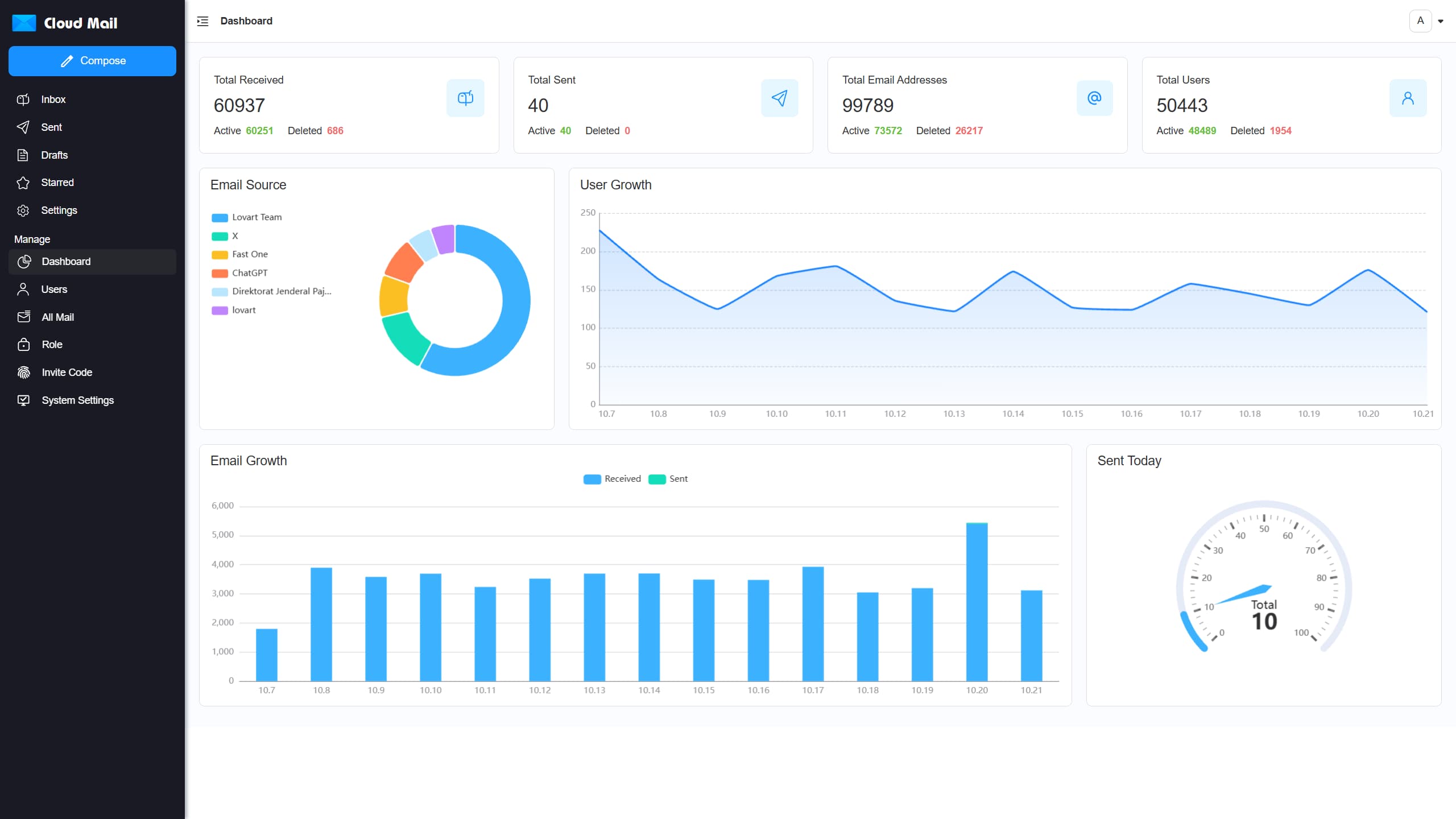
The rest is product rather than plumbing. A user can hold several addresses, and an admin can cap that per role, along with send quotas by day or in total, which domains a role may use, blocked senders and subjects, and invite codes for registration. Turnstile sits on the signup form, GitHub and LinuxDO OAuth are wired in, and a received message can be pushed to a Telegram bot or a webhook. Mail bodies are sanitised with DOMPurify and rendered inside a shadow root, which is the correct order of operations for a client that displays other people’s HTML, and an [ai] binding runs Workers AI over each incoming message to pull out a verification code. The admin dashboard charts users, mail volume and email sources, and there is a public API for batch user creation and mail queries.
Who’s behind it
MailLab is a GitHub organization created in June 2025, with two public repos. The main one has been worked on since April 2025: 290 commits, 13 contributors, 15,605 stars and 23,392 forks on GitHub as of 2026-11-11, and a commit landed this morning. The directory card next to this review shows 15,602, its last sync. The forks outnumber the stars because that is how you install it: the setup guide has you fork the repo and let the included GitHub Action deploy it. The latest release, v3.4.0, is dated 2026-10-23. Most of the code is one person’s. aslost, whose GitHub profile lists Shen Zhen, has 270 of the 290 commits.
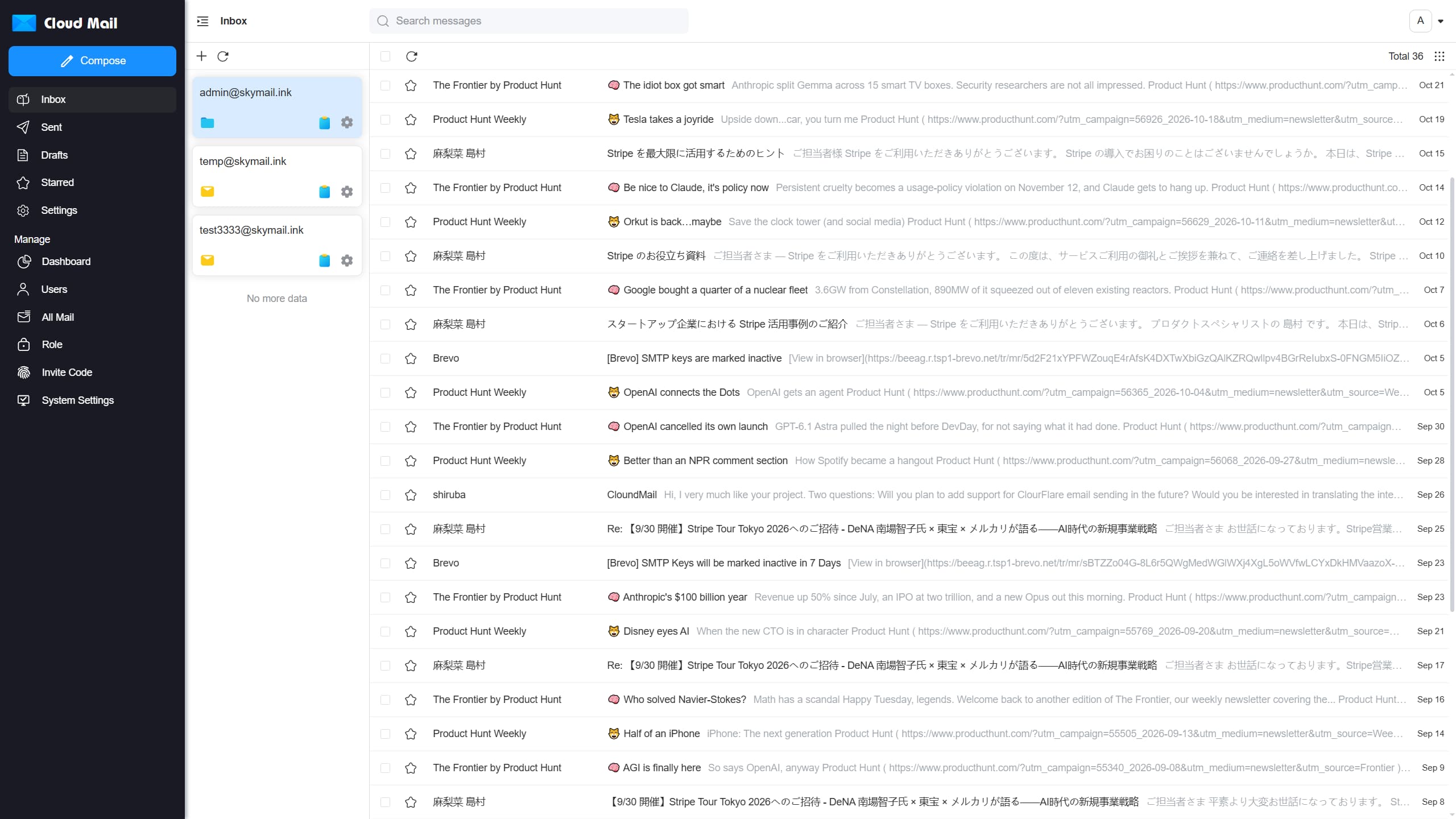
The project is documented in English and Chinese at docs.skymail.ink, demonstrated at skymail.ink, and discussed in a Telegram group. It is MIT licensed, so the screenshots here are reusable.
Where it falls short
- There is no IMAP, SMTP or POP anywhere in the repo. The web app is the only client, so Apple Mail and phone clients have nothing to connect to, and mail cannot be read offline.
- Paid Workers is the real floor. Receiving buffers the whole message and parses it with
postal-mimeinside the Worker, and the free plan allows 10 ms of CPU per request while Cloudflare’s own docs put payload-parsing work at 10 to 20 ms. Outbound mail to strangers also needs a paid plan, since free-plan sending is limited to verified destinations. - The outbound ceiling is 5 MiB. Sends to arbitrary recipients cap at 5 MiB including attachments, with 25 MiB only for verified destinations, and inbound routing caps at 25 MiB. Cloudflare’s sending API is still labelled beta.
- Message bodies live in D1. Attachments go to R2, but the mail itself is rows in a database that stops at 500 MB on the free plan and 10 GB on paid. A single string value there tops out at 2 MB, well under the 25 MiB a message can arrive with.
- Search is a
LIKEquery across subject, body and sender, with no full-text index, and D1 limits aLIKEpattern to 50 bytes, so a search phrase longer than 50 bytes is rejected before it matches anything. - Passwords are salted SHA-256, one round, minimum six characters. SHA-256 is built for speed, and password hashing wants the opposite. If the users table leaks, one round and a six-character minimum make the passwords cheap to recover offline.
- Spam handling is a blocklist. Subject, body and sender strings you write yourself. Anything else lands in the inbox, and the domain’s reputation is yours to defend.
- The test suite is the Wrangler starter’s. One spec file, still asserting “Hello World!” from the template it was generated with.
- The interface is English and Chinese only, and no folders exist, only inbox, starred, sent and drafts.
Verdict
Install it if you want real mailboxes on your own domain for a group of people, are content to read mail in a browser, and would rather pay Cloudflare $5 a month than a provider per seat. Skip it if anyone in the group expects IMAP, a phone client, or a mailbox they would call their main one.
Research and source context
This profile is compiled from public repository data. Repository details were captured and the profile was last researched .
More in Email & Communication
mailflare
A self-hosted alternative to Google Workspace providing custom-domain email, calendar, booking, file storage and AI agents. It deploys to Cloudflare Workers with D1, R2, Email Routing and Queues, and can alternatively run as a single Docker container with SQLite and local file storage.
moemail
A temporary email service that lets users create disposable mailboxes, receive messages in real time, and send mail through Resend. It deploys to Cloudflare Pages using D1 for storage, KV for settings, and Email Workers for inbound routing, and exposes an API, CLI, and MCP server.
vmail
A temporary email service that runs entirely on Cloudflare: an Email Worker receives mail for the operator's domain, D1 stores messages, and Durable Objects enforce quotas, with a React console for managing mailboxes, API keys, and outbound mail. Deployment uses Wrangler and D1 migrations in the visitor's own Cloudflare account.