When Mountains Became Walls
Rea,
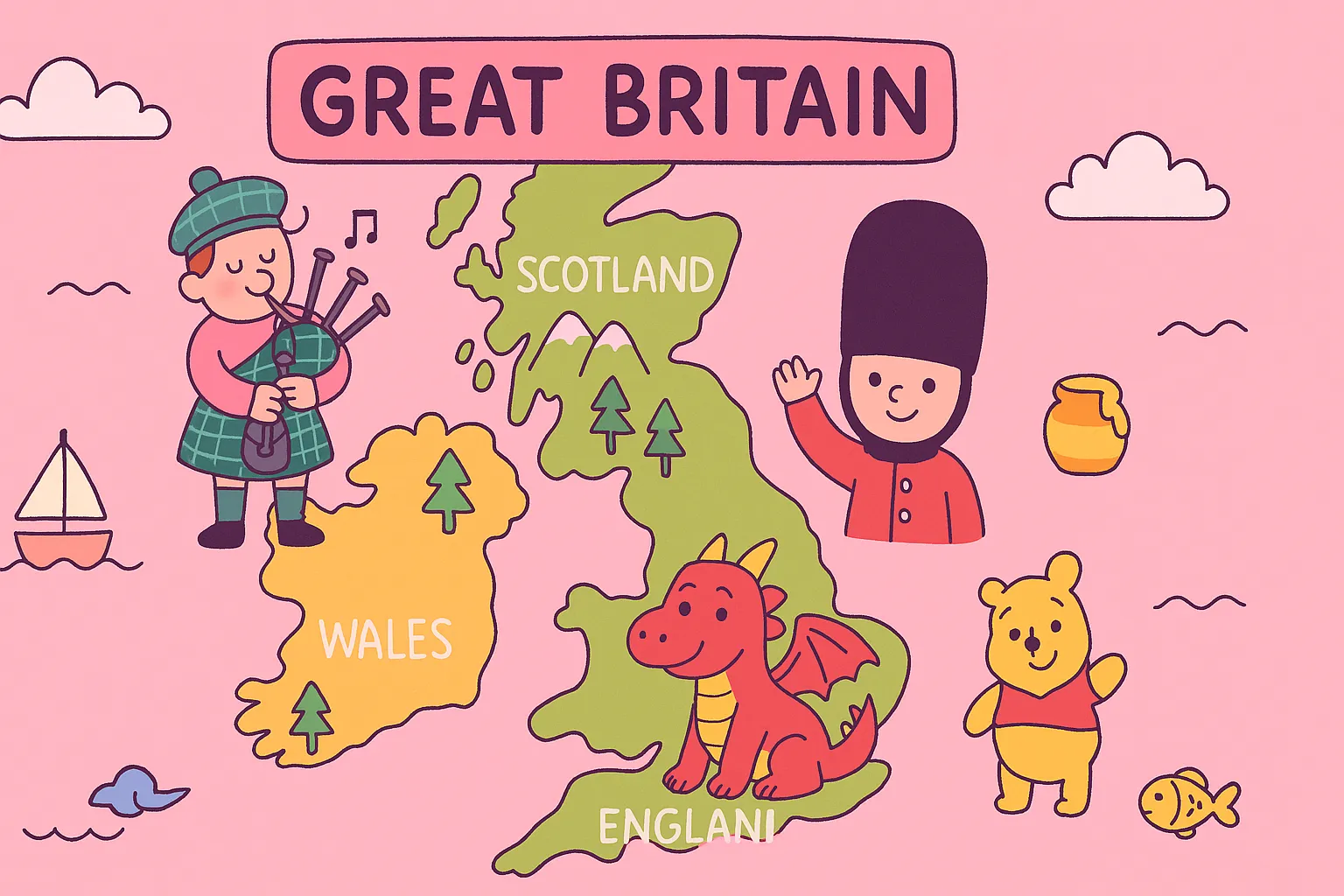
You’ve now been to all three nations that make up Great Britain - England, Wales, and Scotland. It’s pretty crazy that such a small island can have three uniquely different cultures. To put this in perspective: in six hours of driving, we barely made it from Austin to Marfa and never left Texas. But in six hours from London, you’d reach Glasgow, crossing through two different countries with completely different languages. How could that be?
The answer lies in something you experienced firsthand during our travels - those winding mountain roads and narrow train routes. Today, modern engineering lets us tunnel through mountains and build bridges across valleys. But 1,500 years ago, those same scenic routes were nearly impossible barriers.
When the Romans arrived in 43 CE, they conquered England’s flat terrain easily, building straight roads across open fields. But when they reached Wales, everything changed. Those narrow valleys you saw from the train to Cardiff became death traps. Welsh warriors knew every hidden path while Roman legions got lost in the mountain maze. After 400 years of trying, the Romans never fully conquered Wales.
Centuries later, Anglo-Saxon tribes pushed westward, driving Welsh speakers into the mountains. But instead of disappearing, Welsh found refuge in those isolated valleys. Communities just 20 miles apart developed different dialects because crossing the mountains between them took days, not hours.
Scotland tells a similar story with a twist. The Highland Boundary Fault - a geological line you crossed driving north - splits Scotland into two worlds. The Highlands, with their steep glens and narrow passes, preserved Gaelic culture. Meanwhile, the accessible Lowlands developed Scots, a language closer to English.
Here’s where geography gets interesting: Ireland sits only 12 miles from Scotland across the sea. Around 500 CE, Irish Gaelic speakers found it easier to sail to Scotland’s western coast than to cross England’s mountains. They brought their language to the Highlands, which is why Scottish Gaelic and Irish sound similar today.
These geographic barriers created three distinct language communities. Today, about 750,000 people in Wales speak Welsh daily - roughly 20% of the population. Scottish Gaelic has fewer speakers, around 60,000, mostly in the Highlands and islands. English dominates the accessible lowlands and plains.
The result? Three ways to say the same thing. In English: “Happy Wednesday, Rea.” In Welsh: “Dydd Mercher hapus, Rea.” In Scottish Gaelic: “Diciadain math, Rea.” Three greetings shaped by the same mountains that made our road trip so scenic.
Geography became destiny. The barriers that slowed our modern journey once created entirely separate worlds, each preserving its own way of speaking, thinking, and living on one small island.
Love, Abba