When Three Crosses Became One
Rea,
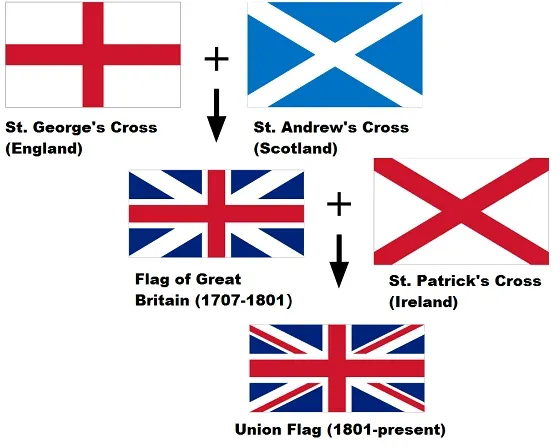
You probably saw the Union Jack flying everywhere during our UK travels - from government buildings in London to castles in Edinburgh. But did you know it’s actually three flags layered on top of each other? Each cross represents a different patron saint from the kingdoms that joined together.
The story begins in 1603 when King James VI of Scotland also became King James I of England. Suddenly, one person ruled two separate countries, each with their own flag. England flew the red cross of St. George on a white background. Scotland displayed the white diagonal cross of St. Andrew on blue. The problem? Which flag should fly over royal ships and government buildings?
James faced a design challenge that would make any artist nervous. Simply picking one flag would insult the other kingdom. Splitting them in half would look terrible. His solution was revolutionary: layer them together. In 1606, he created the first Union Flag by placing England’s red cross over Scotland’s blue background with its white diagonal cross.
But the design created a new problem. When you put one cross on top of another, which one goes in front? James solved this diplomatically. The red cross of St. George sits in the center, but Scotland’s diagonal cross remains fully visible around it. Neither flag disappears - both nations stay represented.
Two hundred years later, Ireland joined the union, bringing St. Patrick’s red diagonal cross. Now the designers faced an even trickier puzzle: how do you add a third cross without covering up the other two? The 1801 solution was brilliant. They split the diagonal spaces, alternating red and white sections so both St. Andrew’s and St. Patrick’s crosses remain visible.
Look closely at a Union Jack and you’ll notice something clever - it’s not perfectly symmetrical. The red diagonal stripes are offset, thicker on one side than the other. This prevents either Scotland or Ireland from appearing more important. Every detail was carefully planned to keep the peace between proud nations.
The result is a flag that tells the story of political union through visual design. Wales doesn’t appear because it was already considered part of England by 1606, but the three crosses represent the major kingdoms that chose to unite under one crown.
Today, about 16 countries still include the Union Jack in their flags, from Australia to Fiji. Each time you see those layered crosses, you’re looking at a 400-year-old solution to the challenge of representing multiple identities in one symbol.
The Union Jack works like a perfectly balanced equation - three separate parts that create something stronger together while keeping each piece visible and valued.
Love, Abba