When a Teenager Changed Two Countries
Rea,
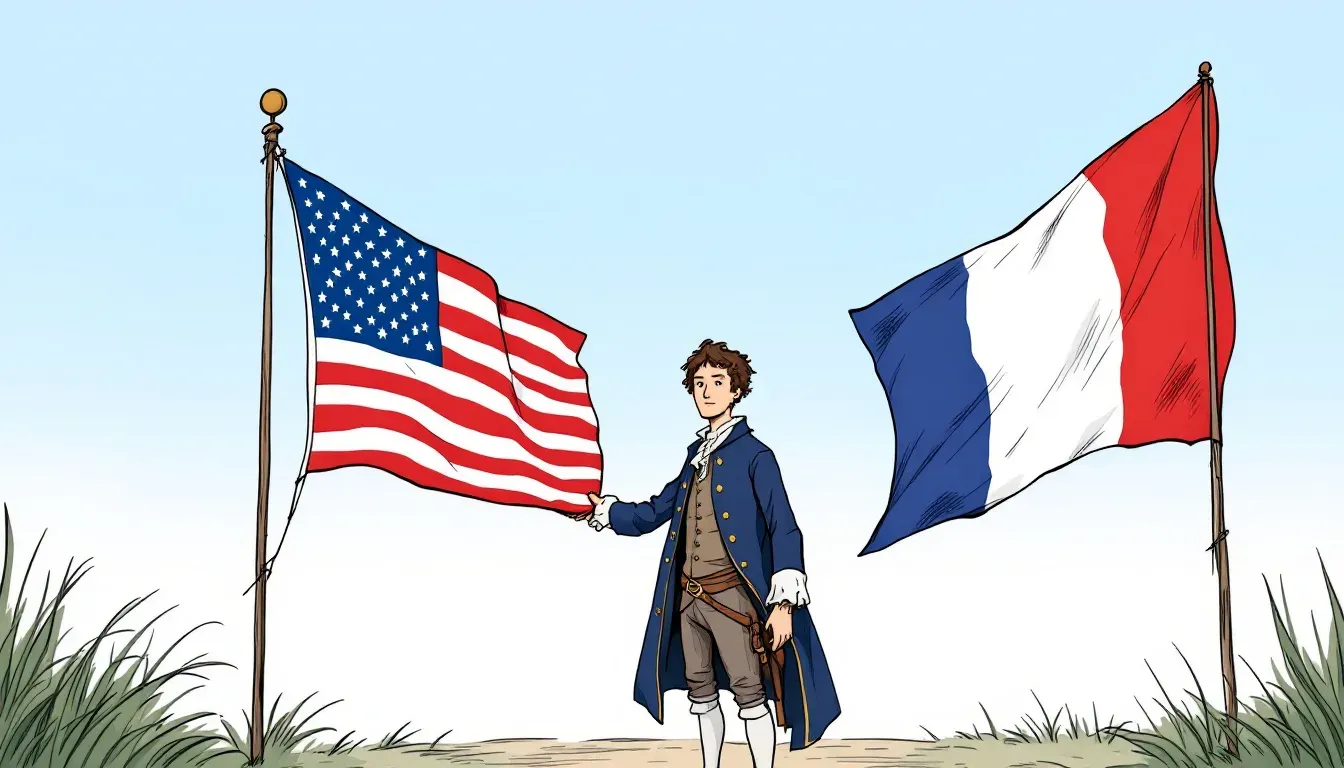
You love the “Mon Ami” song in Hamilton, and here we are in Paris where Lafayette’s incredible story actually began. That got me thinking about something remarkable - how a teenager’s decision in this very city ended up transforming two entire countries.
In 1777, a 19-year-old French aristocrat named Gilbert du Motier, Marquis de Lafayette, was living comfortably in his family mansion in the Faubourg Saint-Germain area (near where we walked by the National Library). He had everything - wealth, status, a young wife, and a baby daughter. But in the fashionable salons of Paris, he kept hearing whispers about something extraordinary happening across the Atlantic Ocean.
Think of these salons like the cafés you see in Saint-Germain-des-Prés or Montmartre - places where intellectuals gathered over dinner and drinks to discuss the latest news and ideas. American representatives like Benjamin Franklin (who lived in Passy, right where we walked on Rue de Passy!) and Silas Deane had come to Paris seeking French support for their revolution against Britain. They attended these salon gatherings throughout the city, sharing stories of colonists fighting for liberty and self-governance. These ideas - that people could choose their own government and that all men were created equal - were revolutionary concepts that fascinated young French aristocrats.
Lafayette faced a choice. He could stay in his comfortable life, or risk everything to join a cause he’d never seen. The French king had forbidden French citizens from helping the Americans. Lafayette could lose his fortune, his title, even his life.
But something about the American cause captured his imagination. Using his own money, he secretly bought a ship called La Victoire and sailed to America in 1777. He was so committed that he served without pay and was wounded at the Battle of Brandywine, where he met and befriended Alexander Hamilton.
What Lafayette brought back to France changed everything. He returned with firsthand experience of the Declaration of Independence principles. He had seen a society where merit mattered more than birth, where people could speak freely about government, where representatives were chosen by the people.
These ideas spread through the same Paris salons where Lafayette had first heard about America. By 1789, just twelve years after his return, France erupted in its own revolution. Lafayette even wrote the first draft of the Declaration of the Rights of Man and of the Citizen, using language directly inspired by the American Declaration of Independence.
The impact was extraordinary. Lafayette’s American experience helped secure crucial French military support that won the Revolutionary War. Without French ships, soldiers, and supplies, America might never have gained independence. Meanwhile, the revolutionary ideas he brought back to France sparked changes that spread across Europe.
Today when you visit the American Library in Paris, you’re walking in the footsteps of this centuries-old connection between American and French ideas. The library continues the tradition of cultural exchange that began when young French aristocrats like Lafayette heard about American liberty in Parisian salons. And when you pass by a Lafayette metro station, you’re seeing how Paris still honors this teenager who changed history.
From the Marais to Passy, from the canals near our apartment to Montmartre, you’re walking through neighborhoods where these revolutionary ideas first spread from America to France and back again. Think of Lafayette as a bridge connecting two revolutions. His teenage decision to cross an ocean didn’t just change his own life - it helped create the America we know and sparked the democratic movements that transformed Europe. Sometimes the biggest changes start with one person brave enough to cross the bridge between what is and what could be.
Love, Abba