ember-cloudflare
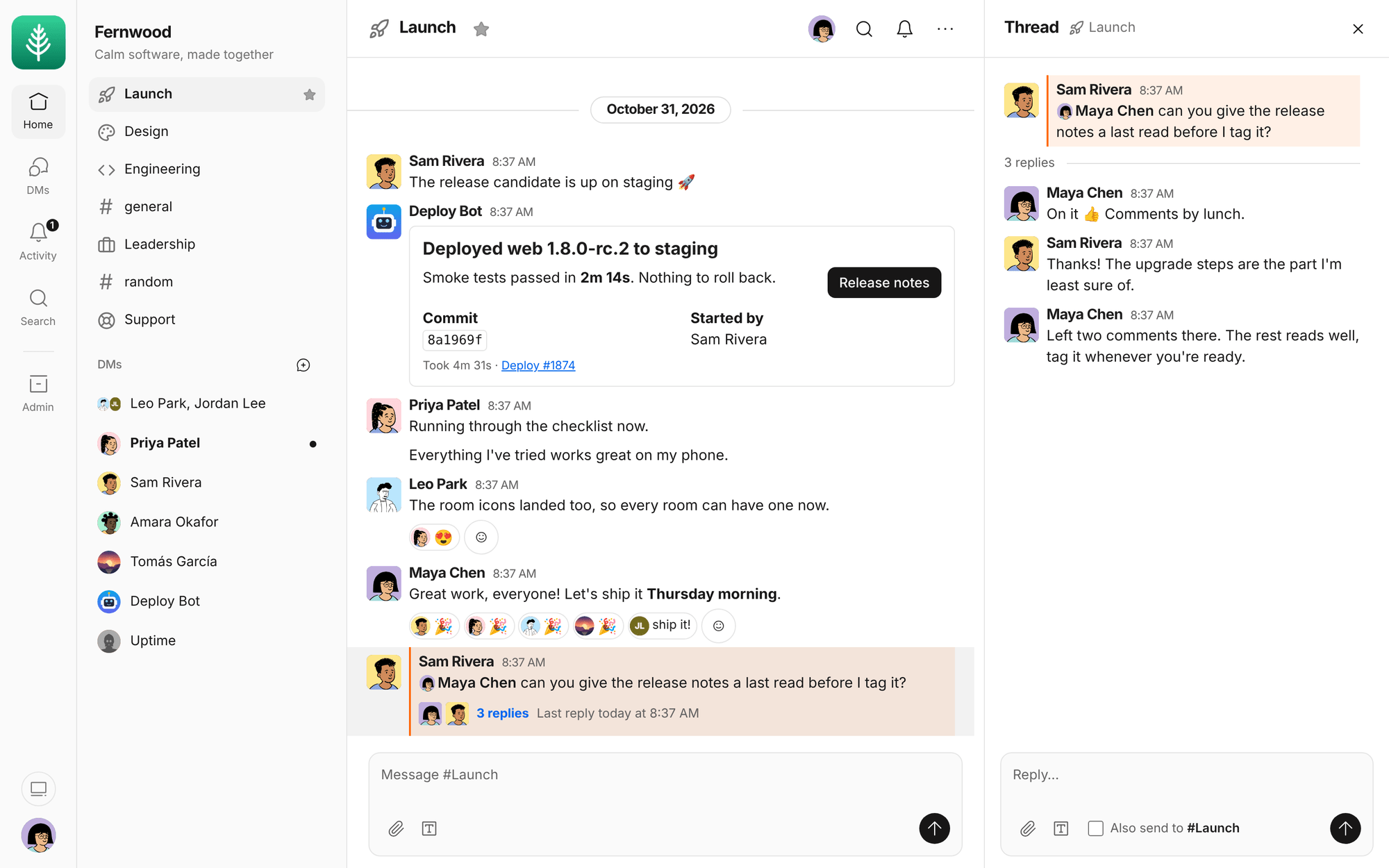
Ember is an open-source team chat application offering rooms, threads, direct messages, file sharing, search, Slack-compatible bot webhooks, and optional AI agents. It deploys into a visitor's own Cloudflare account through a one-click button, keeping messages in Durable Objects and shared files in an R2 bucket.
- Stars
- 1,188
- Forks
- 142
- License
- MIT
- Category
- Email & Communication
- Latest push
- Published
- Refreshed
- Updated
Review
The bill it replaces
Slack bills per person: $7.25 a month each on Pro when paid annually, $15 on Business+, and the free plan keeps 90 days of history and ten apps (slack.com/pricing). Twenty-five people on Pro come to $2,175 a year. The open-source way out has been 37signals’ Campfire, MIT licensed and shipped as one Docker image you run on a machine of your own (once-campfire). That swaps a subscription for a server you have to run, which means paying for the VM, patching the container and backing up the volume.
What Cloudflare gives you, and the gap
Durable Objects are the primitive a chat app needs, and every Cloudflare account has them. One object can hold a room’s live WebSocket connections, who is typing and the messages in SQLite inside that object, then hibernate when the room goes quiet. Workers answer requests, R2 stores the files and charges nothing for downloads. What none of it provides is chat. A room object with a socket attached is plumbing; a team needs rooms, threads, presence, unread counts, search, permissions, an admin panel and a way to get in.
What Ember packages
Ember is Campfire’s feature set rebuilt on those primitives, and its config reads like the argument for doing it that way. One Worker serves the React app and the API. Five Durable Object classes hold the state: a ChatRoom per room, a Workspace for what the rooms share, a SearchIndex, and two short-lived objects, PasswordHasher and Unfurler, which take the work too heavy for the 10 ms of CPU a request gets on the free plan. Rooms accept sockets through the hibernation API and answer pings with an auto-response pair, so a quiet room with people connected costs nothing. Messages go to each room’s own SQLite by default, or to a single D1 database when STORAGE_BACKEND is set to d1. That second option suits anyone who would rather query and export the messages with SQL. Files land in an R2 binding, and email leaves through Cloudflare Email Service or a Resend key.
The surface is broader than a first version usually manages: threads with a reply-also-to-the-room switch, per-room notification levels, search that keeps Slack’s room, person, link and thread filters, Slack-compatible incoming webhooks with attachments and Block Kit cards, bots that answer a mention within 30 seconds, join links and QR codes, email-domain and Memberful sign-in, Turnstile, push notifications, and an installable phone app. Audio huddles run on Cloudflare’s Realtime SFU, though the README’s own Slack comparison still marks voice calls as Slack-only.
Who’s behind it
Ember belongs to NYLLON, a GitHub organization created in November 2025 with four public repositories and a site describing a membership for “builders, thinkers, and the perpetually curious” that is still a design preview. The repository is four weeks old: created October 12, 2026, 1,016 commits from four accounts, 535 stars and 33 forks on November 10, and ten releases between v0.1.0 on November 1 and a v0.5.0 beta on November 10.
The commit log says who wrote it. The busiest account is claude, credited with 744 commits under an @anthropic.com address, and the changes arrive as pull requests from branches named claude/project-thread-…. Kevin Rose (kropdx) has 266, Sheing Ng four and Matt Van Horn two. Campfire, the project this rebuilds, has 4,821 stars and 827 forks, and the LICENSE file carries 37signals’ copyright line beside NYLLON LLC’s.
Where it falls short
- The free plan is measured in rows. Ember’s own measurement from October 2026 puts a message at about 20 Durable Object rows written (13 in its room, 5 in the search index, 2 in the workspace), against 100,000 rows a day on the free plan. That is 3,000 to 5,000 messages a day for the whole team, and once a day’s rows are gone nothing new is saved until midnight UTC. Workers Paid lifts the ceiling for $5 a month for the account.
- One community per deployment. Each Ember gets its own Worker, R2 bucket and database, and the deploy form creates the database even when messages stay in Durable Objects.
- One object answers every search. The index is a single Durable Object named
searchholding every room’s message text, so search traffic never spreads across rooms. - The edges are unfinished. Full export of messages, DMs included, is listed as missing in the project’s own comparison, files stop at 250 MB against Slack’s 1 GB, and huddles need their own SFU app and secret, skip DMs and carry no video.
- A deploy token to trim. Deploy to Cloudflare issues a build token that may edit nearly everything in the account, R2 buckets included, and the setup guide asks you to narrow it to four or five permissions by hand.
Verdict
If your team lives in rooms, threads and files, and you would rather pay Cloudflare $5 a month for the whole account than Slack $7.25 a person, Ember covers that ground and keeps every message while you do. If your work depends on Slack’s app directory, workflow builder, guest accounts or long-retention compliance controls, the subscription is still the cheaper decision.
Research and source context
This profile is compiled from public repository data. Repository details were captured and the profile was last researched .
More in Email & Communication
cloud-mail
A self-hosted multi-user mailbox platform that runs on Cloudflare Workers, letting an operator create many addresses on their own domain. It uses D1 for data, R2 for attachments, KV for caching, Cloudflare Email for sending and receiving, plus Workers AI for verification-code detection and Turnstile for bot protection.
mailflare
A self-hosted alternative to Google Workspace providing custom-domain email, calendar, booking, file storage and AI agents. It deploys to Cloudflare Workers with D1, R2, Email Routing and Queues, and can alternatively run as a single Docker container with SQLite and local file storage.
moemail
A temporary email service that lets users create disposable mailboxes, receive messages in real time, and send mail through Resend. It deploys to Cloudflare Pages using D1 for storage, KV for settings, and Email Workers for inbound routing, and exposes an API, CLI, and MCP server.